Showing posts with label work. Show all posts

Tuesday, 27 August 2013

Until We Meet Again (Closeout Stats)

My maternal grandfather refused to say goodbye.

Instead, his words of farewell were "Until we meet again."
Sunset on the Waimakariri near Arthur's Pass National Park. The river forms
a classic winding braid over its gravel bed, an important habitat for many
native New Zealand species, including insects and some nesting birds.
Those are the words I always repeat to myself as I pack up shop at Landcare Research and leave New Zealand once again. Just as every trip introduces me to new wonders that make me love this spectacular country more, every departure makes me long for the next return more than the last.

Eyes glued to the dissecting scope in my classic work pose.
Photographed by I.A. Dickie.
Following tradition, here's a numerical summary of this trip to New Zealand:

Root tips counted: 138,755
DNA samples taken: 3,435
Chocolate consumed in this endeavor: At least 4kg
(Did you really think I was bringing some of my chocolate home to share?)

A visitor in the lab!
Kilometers driven in rental car: 1217
Wipers-instead-of-turn-signal errors: 2
American (counter-clockwise u-turns): 1
"Correct" U-turns: 3 (I'm getting better!)

Bottles of NZ white sampled: 4 (plus a Californian pinot by Cline Cellars enjoyed with J)
Servings of fish and chips: 3 (Yeah, I'm enjoying my social omnivory... :)

Time until return to NZ: hopefully a matter of months...

Saturday, 17 August 2013

The Rate-Limiting Step

Must. Go. Faster.
Must. Go. Faster.

That's the basic mantra I repeat to myself as I perch next to the microscope, rapidly scanning root systems, typing data into the computer, and plunging root samples into chemical buffers.

There's a basic principle in biochemistry which says, essentially, that a reaction can only go as fast as its slowest step.

It follows the same idea as the old phrase, "A chain is only as strong as its weakest link." Or, in Bay Area lingo, you'll only get to SF from the East Bay as fast as traffic on the Bay Bridge will let you, no matter how clear highways like the 580, 680, and all the other 80's are. The rate at which cars can squeeze through the narrow trans-bay span becomes the rate-limiting step to transportation.

These days, I'm the rate-limiting step.

As always here at Landcare, I've had terrific help with my harvest. The seedlings must be carted in from the glasshouse, measured, and washed clean of dirt before I can inspect their root systems under the microscope. (We're also taking soil samples in case we want to do some further genetic and biochemical analysis.) K. works as efficiently as always, preparing the seedlings two-at-a-time and stashing them in water-filled plastic cups to await my attentions.

It takes about fifteen minutes for me to process a seedling, so I'm expecting to spend about 100 hours on the microscope while here at Landcare. Together with the time required to extract DNA (and make backup copies of the samples I'll be carting back stateside in case of issues with United States border security), I'm expecting to be rather tight on time on this trip.

As of end-of-day on Saturday, I'm through 152 of ~500 seedlings, optimistically on track to make my Tuesday flight. I've tallied 55,176 root tips, and taken 1,374 DNA samples.

Still, I haven't looked in the greenhouse at those ominous rows of Douglas-fir seedlings awaiting their turn to face the wash-and-clip treatment. When I think of heading out there tomorrow to survey progress and collect more samples, I can't help but remember a recent conversation with K.:

"So does it look like we're making any progress," I ask K. as she returns from the greenhouse with the latest tray of seedlings.

She pauses for a moment. "Err.... No."

I sigh, then grab the latest batch of washed seedlings and head back to the microscope.

Saturday, 10 August 2013

A Case of the (Missing) Mondays

Last month, when I boarded a plane to Canada for a math conference, I thought affectionately that I was glad that the last stamp in my passport, which expires in October, would be from my beloved Northern neighbor.

I didn't expect to be headed to New Zealand for another stamp before I sent my passport off for renewal. But, as those of you who saw me in my most frantic moments at the Ecological Society of America Annual Meeting this week know, sometimes surprises happen.

 This time, the surprise came on Monday: an email from a colleague who'd been kindly keeping an eye on my seedlings in New Zealand. "There's a fungus among us," he wrote -- or something of the sort. Or, to use another trite turn of phrase, "Houston, we have a problem."

Friday, 21 December 2012

"Well before I'm northward bound..."*

As I begin to pack up my five-and-a-half week stay in New Zealand, I thought it might be nice to document some of the fun the last week has brought my way. I was drawn to science because of its variability: It's rare that I spend more than a few days -- much less a few weeks -- doing the same thing. Which means that I'm never stuck on a dull task for very long, and that I occasionally get weeks like this one, which remind me how lucky I am that I get to play for a living and how much joy I get from my job!

Having finished up his seedling harvest, I spent Monday with J. at the Canterbury Museum, where I got to dust off my dSLR (which got hauled down here, telephoto lens and all, only to sit on the shelf while my point-and-shoot saw most of the action) to photograph some of the bones that he was measuring. Many of the photos will hopefully see some use as reference photos, since we posed them to highlight morphological differences between species. 
Bird-brained?
I absolutely love going behind-the-scenes at museums, and it was so cool to get a glimpse of the avian collection -- especially some enormous Moa bones!

And if that weren't enough, I also got treated to a couple evening trips to the seaside, once with K. to enjoy a bottle of our favourite wine, and once for a nice long run, as the shadows slowly stretched out in the lingering summer dusk. It's going to be hard to adjust to the short days of the Northern Hemisphere winter next week.
Sumner: the perfect spot for a beach run!

Thursday, 13 December 2012

Fir is Murder! (Or: The Value of Scientific Collaboration)

About year ago -- before I did any field work in New Zealand; indeed, before I was even certain I'd be working on Douglas-fir in New Zealand -- I went for a run around the Stanford campus and passed a Christmas tree lot.

A lifelong tree-hugger, I was reminded of my annual childhood distress at the start of each New Year, as my Dad and I, walking around the neighborhood, bore witness to the ignominious disposal of many a family's Christmas tree. (We'd always had a lovely little artificial tree, passed down from my Dad's relatives. I think this was mostly to avoid the myriad cleaning joys of a tree shedding needles everywhere, but I chose to interpret it as my family's deliberate efforts to save baby trees.)
I mean, we wouldn't have these beautiful Canadian running
trails if someone cut down all these trees for Christmas!
(Err... let's not discuss the logging situation in B.C.)
When I got home from my run, I told Luke about the horrors of the Christmas tree lot, and he told me that every single year, his family had a lovely real tree, and that it wasn't Christmas without its delicious conifer smell permeating their house.

"Well," I spluttered. "Well... That's twenty-five years of murdering baby trees for you!"

Several days later, I'd come up with a slogan and was feeling very clever about it. "FIR IS MURDER!" I'd bellow at Luke every time one of us entered or left our apartment. (Fortunately for him, I have the memory of a tunicate, so I didn't keep this up for long.)

Tuesday, 4 December 2012

The Dynamic Duo and Their Microscopy Minion (or: Anatomy of a Harvest)

Ladies and Gentlemen, your cast, in order of importance:
The Dynamic Duo, a.k.a. the Able-Bodied Assistants, a.k.a. the best money Holly ever spent on science
The Microscopy Minion, a.k.a. Holly -- and her bloodshot eyes, too

The Backstory:
Many weeks ago, in a land far, far away, through the mysterious portal of Skype, Holly and her thesis committee members conferred.

"My, what a fine set of data we'll have," they remarked as they contemplated the upcoming harvest of more than five hundred Douglas-fir seedlings. "And we'll have a whole bank of little seedlings, all with their own tiny root system communities of ectomycorrhizal fungi. Whatever shall we do to torture them next?"
Seedlings waiting to be victimized. Note the adorable straw-
and-sticker labeling scheme, which cost S. and I an afternoon.
"Well," said Holly, feeling too ambitious for her own good, "Let's do something high-risk."

"Well," said Holly's advisor, "Let's do something involving community assembly."

"Well," said the NZ team, "Let's do something involving conifer invasion risk."

"Well," said the Stanford crew, "Let's do something cool."

Thursday, 22 November 2012

On Gratitude

Happy Thanksgiving, United States-ers!

Once again, I've managed to be out of the country for my favorite holiday. (Well, favorite outside of the day after Easter, which I celebrate with my credit card and circuit through all the major grocery stores within 5 miles.)

Last year, I ate amazing smoked turkey with friends, collaborators, and future founders of "The Ukranian Journal of Looking at Animals" (future home of many a paltry thesis chapter?) in Montreal and was grateful for a warm dinner, laughter, and snow on the ground.

This year, I had an even stronger prompt to remember all there is to be thankful for. Because my experiment failed.

That's right: Those cute Douglas-fir seedlings, looking all fat and happy in their posh greenhouse, had next to no ectomycorrhizal fungi on them at all.

Individually tagged, pulled out of the PVC
pipe, and ready for washing!

We're not sure why the experiment failed.

Thursday, 15 November 2012

"Teach me how to Dougie"

Six months ago at a beach cleanup day, I learned from a local DJ -- and about 100 dancing middle-schoolers -- about a new dance called the "Dougie."

As someone with little demonstrable sense of rhythm, I'll leave it to you to look up the YouTube videos and learn the moves.  But what I can teach you here is a different, nerdier form of Dougie-ing.

Seventeen hours, two plane flights (complete with early meal delivery thanks to my new vegetarianism!), and one skipped Wednesday (thanks International Date Line!) after leaving San Francisco, I found myself in a newly-renovated Christchurch airport. A very generous J. had come to greet me as I exited security, in spite of having just flown through himself after returning from a stint in Australia just a few hours before.

"Well, are you game to just head straight out to Landcare, then?" he asked.

And off we went!

I was excited to see the progress my little greenhouse buddies had made in my absence!

Each one of the 264 pots holds two Douglas-fir seedlings,
most of whom seem reasonably delighted by their surroundings.

Sunday, 11 March 2012

The 190th Hole (Anatomy of Soil Sampling)

The past week -- and the week to come -- are all about digging.  More precisely, they're about hammering a short segment of PVC pipe into the ground, and then digging.

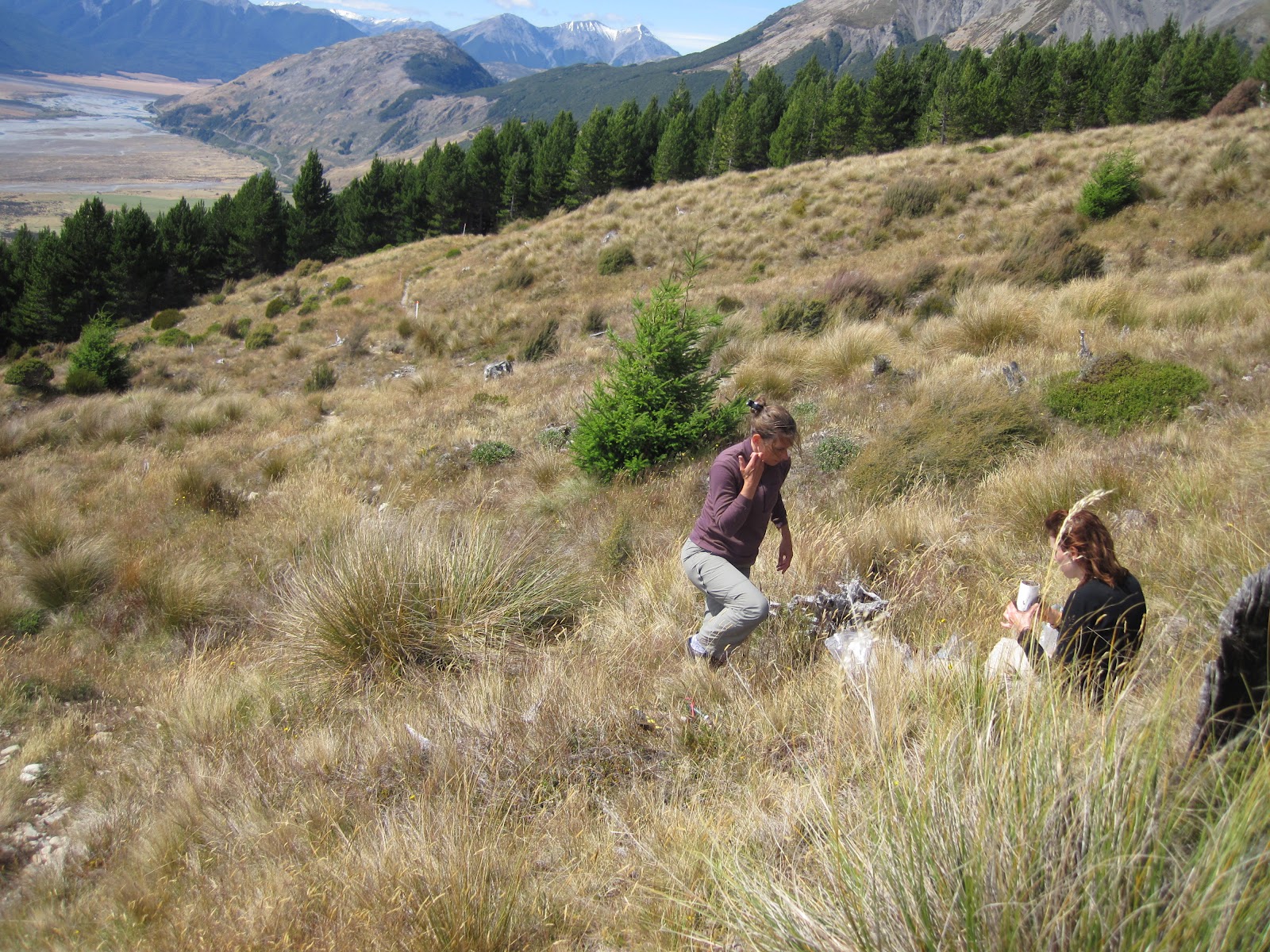
K. and J. extracting samples from a grassland. You can see a
pine plantation in the background, and a wilding Douglas-fir
just behind K. (in the purple shirt). The white tube in J.'s hands
is a newly-extracted soil core.
Together with the help of K. (who knows all the best ice cream spots on the South Island) and J. (who's generously loaning her strong arms and back in the name of seeing more of New Zealand), I'm collecting soil samples for a greenhouse bioassay (a glasshouse-based experiment using living organisms to test the properties of an environment).

This experiment is the natural complement to my survey of fungi infecting existing seedlings. In this case, I'm collecting soil from the same three canopy types (grassland, native beech forest, and Douglas-fir forest) at sites spread across the South Island of New Zealand (rather than the few local sites at which I collected my seedlings).  I'll plant Douglas-fir seeds in these soils, allow them to grow in the greenhouse for 6 to 9 months under the watchful eye of some helpful Landcare folks who will keep them happy and watered for me, and then harvest them to find out what fungi from the soils colonized the seedlings.

Wednesday, 29 February 2012

Teaching a sprinter to run marathons (Anatomy of lab work)

I've always been an endurance athlete.  Probably because I'm just plain slow, and you can hide that a lot better in a 5K than in a 100-meter dash.
This Douglas-fir seedling has lost its chance to take over the world.
Or at least, the surrounding native forests. 
For the most part, after more than a decade of semi-competitive running (though over the last few years it's been more about the pleasure of stretching my legs over a few miles than about lowering personal records), my brain has been molded into that of a distance runner.  I like to stick things out, I like a certain amount of pain (I can picture Mom and Dad making their 'self-flagellation' gestures... thanks for the emotional scarring, guys! :), and -- according to Dad, anyway -- I have a reasonable degree of mental toughness.

But in some things, I will always be a sprinter.

To some extent, I espouse Hemingway's "Live hard, play hard" dogma: I have a tendency to throw myself into science and work feverishly for a few weeks or months, then wear myself out and collapse in a fit of TV-watching, elaborate-meal-cooking relaxation.  (Err, I guess that's not really relaxation... more like throwing myself into something else, equally intensely.)
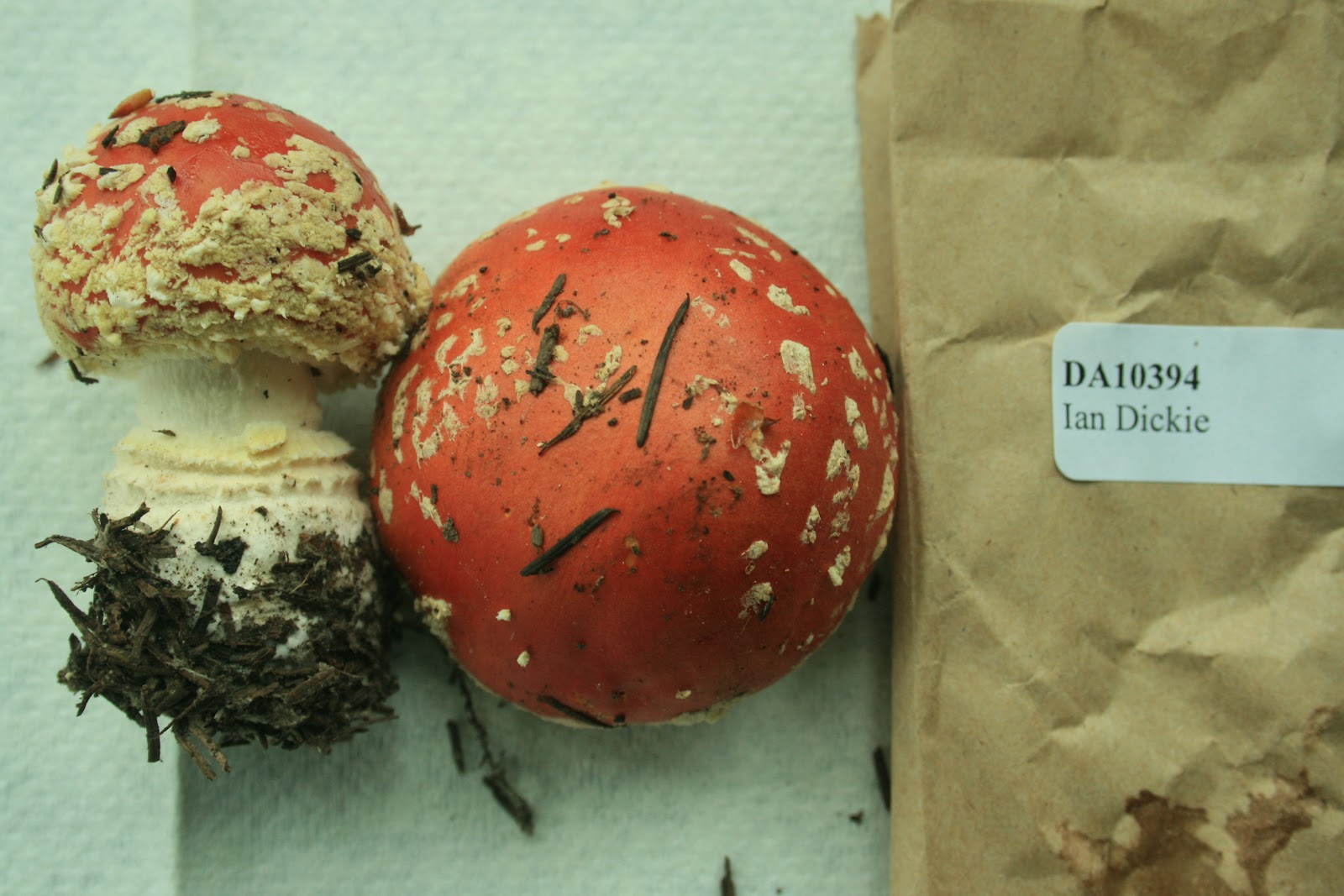
In addition to seedlings, we also collect any sporocarps (mushrooms,
the fruiting bodies -- a.k.a. the physical structures that release spores,
the reproductive part of a fungus) that we find in the field.  These are
brought back to the lab for DNA sampling, photographed, and dried.
I've never been very good at pacing myself when it comes to work.  So it's no surprise that, where we said we'd collect 15 seedlings per canopy type, we came home with closer to 30.  And now, with bags and bags of samples piled up in the freezer, I'm feeling some perturbation, which is currently manifesting itself in nightmares in which I open the door to the cold room and am instantly toppled by a tidal wave of Douglas-fir seedlings that come pouring out.  (Silver lining: This is a much better dream than last week's, which featured an unfortunate encounter with a band saw while cutting sample tubes for the second half of my field work.)

As I know from experience, there's only one cure for this dream-inducing stress: Getting to work! With one sprint into the field over, it's time for the sprint to finish up lab work before the next phase of my project.  Here's how it's done.

Saturday, 25 February 2012

Orion is upside down! (Anatomy of field sampling)

On Monday night, to celebrate the completion of the field survey, I stayed up long past sunset (working on this column, actually) in order to check out the Southern Hemisphere's stars.
One of many, many Douglas-fir seedlings we've collected in the past weeks.
It was a remarkably clear night up in Hanmer (location of the Hanmer Hot Springs, which we skipped, and one of the worst wasp infestations I've seen, which we sampled in), and the tiny town offered very little light pollution.  So I got my first look at an upside-down sky.

I only recognized one constellation, Orion (my "cellestial boyfriend").  And he was upside down.

"No, he's not!" K. said.  Though born and raised in Germany, she's been in NZ for more than a decade and a half, so this disconcerting reversal is normal for her.

"But his sword is pointing up instead of hanging down..."

Feeling troubled, I went back to my room in our rented Kiwi batch.  (We stayed overnight in someone's vacation home.  One wall of the living room was literally plastered with pictures, from which K. and I decided that the family had three children, one of whom was now married with a child of his own, and the parents loved taking pictures of themselves with statues.  And bathing in the... erm... nude.  Naughty bits safely underwater, fortunately.)  It was 10:30pm, way past my bedtime (yes, I am an old lady), and I was ready for bed.

Friday, 24 February 2012

"I've never been stung."

"Are you allergic to bee stings?" Ian Dickie, local fungal expert and key collaborator on my work in New Zealand asked.

"I've never been stung, actually," I replied.

Ian swore.  Not an unusual occurrence, but a particularly vehement example.  "Well, let's make sure we grab a wasp kit, then."

Wasp kits here are lightweight packs of antihistamine cream, a couple bandages, an inhaler, and vials of adrenaline.  No epinephrine pens for us: if you go into anaphylaxis in the field, someone will be snapping open a glass ampule and shooting you up with a syringe they filled themselves.

I like to think that, if I were in such dire straits, I wouldn't care.

So far, so good.  I'm more than halfway through my stay in New Zealand, and through much of the most treacherous part (from a wasp perspective), and no one in my field team has yet been stung.  We're quite proud of the fact, but we knock on wood every day.

Looking up at the Mountain Beech canopy.  We mostly don't do this, since
it's easier to avoid stepping into wasp nests (dug into the ground) when you're
actually looking down at where your feet are going.

Friday, 3 February 2012

A Field Teaser

This week, we finally pinned down a sampling design for my field survey!

You can spend all the time you want having academic discussions in offices, but when it comes to field work, you've really got to go have a meeting in the field.

For those of you who don't know, I'm in New Zealand studying an invasive tree, Pseudotsuga menziesii, better known to most of you as Douglas-fir.  Doug-fir's also known as "Oregon" around here in New Zealand because it's found all across that state back home.  It's actually one of my favorite trees -- I adore the Pacific Northwest, and though Doug-fir wasn't part of my Juneau experience, I've subsequently seen it in British Columbia, been surrounded by it on the Olympic Peninsula, and spotted it all over Oregon and California.

Douglas-fir growing happily in the rainforests of Olympic National Park.

Monday, 23 January 2012

Oh, the Mondays

Some of you (Hal!) may have noticed one stray post claiming to be from the future (a.k.a. 2013) constantly hovering on the top of my blog.  It's not actually from the future -- it's just pretending to be, so that there's a constant introduction to the site for new visitors.

Now for something from the present:  It's Monday here in New Zealand, so while the rest of you have been preparing to watch epic football* games, or going looking for amphibians, or sleeping late, I've loaded up a backpack, hopped on a loaner bicycle, and pedaled 14km (about 8.7 miles) into work to start my day.

Inspired by my Stanford labmate Rachel, and my very dear friend and former roommate Li Ling, I've decided that real scientists bike at least 5 miles to work every day.  (Actually, this new method of transport was really inspired by a scheduling conflict with my landlord, Hugh, with whom I usually carpool in to work at Landcare Research.)

It's quite the pleasant ride -- when you're not worried about getting lost, that is!  I can see myself getting quite accustomed to it over the next few days -- hopefully so accustomed that I remember to stop for pictures to show you all!  All in all, it's just part of the transformation of Holly, from soft-and-lazy desk worker to hard-core field biologist!  (Yeah, we'll see how long this lasts... probably until the first time I encounter a steep slope or a wasp's nest in the field, and run away screaming.)


*A note on sports:  Here in New Zealand, the big ones are cricket and rugby.  My landlords (Hugh and Robyn) are tremendous sports fans, and have been slowly teaching me the rules of cricket.  When rugby season starts next month, I'm sure I'll learn all about that, too!

As most of us know, there's general confusion between Americans and the rest of the world about what "football" means.  I've learned to specify "American football" in most cases, but here in NZ, it's called "gridiron."  All right, that's well and good.  So does "football" mean soccer?  Nope!  Here's the jargon, as best I can map it:

Gridiron -- American Football
Soccer -- Plain old black-and-white ball soccer (but the uncool term for it)
Football -- Used to mean rugby, but slowly coming to mean soccer.  Except that there's some complication Hugh was trying to explain to me about several different kinds of football in Australia and.... oh well.