Wednesday, 22 January 2014

Kia Ora!

Haere mai, or Welcome!  You've found Holly's pseudo-travelogue chronicling her adventures abroad as she conducts Ph.D. Thesis research in New Zealand.

Feel free to subscribe the the site, join the list of followers, or repost content via Facebook or other social media.  The more the merrier!

Because I'll be simultaneously filling my family in on mundane details (like my awesome orange-and-black bedroom) and explaining my research in bits and pieces, I also welcome any and all comments (you can post them at the end of any of my entries) and questions you'd like to post.  And if you're sick of hearing about trees and fungi all the time, check out my weekly columns in the Stanford Daily, yet another mass of non-work writing I love doing!

Tuesday, 27 August 2013

Until We Meet Again (Closeout Stats)

My maternal grandfather refused to say goodbye.

Instead, his words of farewell were "Until we meet again."
Sunset on the Waimakariri near Arthur's Pass National Park. The river forms
a classic winding braid over its gravel bed, an important habitat for many
native New Zealand species, including insects and some nesting birds.
Those are the words I always repeat to myself as I pack up shop at Landcare Research and leave New Zealand once again. Just as every trip introduces me to new wonders that make me love this spectacular country more, every departure makes me long for the next return more than the last.

Eyes glued to the dissecting scope in my classic work pose.
Photographed by I.A. Dickie.
Following tradition, here's a numerical summary of this trip to New Zealand:

Root tips counted: 138,755
DNA samples taken: 3,435
Chocolate consumed in this endeavor: At least 4kg
(Did you really think I was bringing some of my chocolate home to share?)

A visitor in the lab!
Kilometers driven in rental car: 1217
Wipers-instead-of-turn-signal errors: 2
American (counter-clockwise u-turns): 1
"Correct" U-turns: 3 (I'm getting better!)

Bottles of NZ white sampled: 4 (plus a Californian pinot by Cline Cellars enjoyed with J)
Servings of fish and chips: 3 (Yeah, I'm enjoying my social omnivory... :)

Time until return to NZ: hopefully a matter of months...

Monday, 26 August 2013

The Adventures of the Brave Little Tomato Sauce Bottle

What would life be without a bit of adventure?

Sunrise and full moon over the Southern Alps.
With some luck, and the intensive root-washing efforts of K and F, I was able to finish my experimental harvest in time to have a weekend free to explore! Together with my new favorite travel companion -- a genuine tomato-shaped NZ tomato sauce bottle, a gift from Jamie - I took off South and West to explore parts of the South Island both new and familiar.

Saturday, 17 August 2013

The Rate-Limiting Step

Must. Go. Faster.
Must. Go. Faster.

That's the basic mantra I repeat to myself as I perch next to the microscope, rapidly scanning root systems, typing data into the computer, and plunging root samples into chemical buffers.

There's a basic principle in biochemistry which says, essentially, that a reaction can only go as fast as its slowest step.

It follows the same idea as the old phrase, "A chain is only as strong as its weakest link." Or, in Bay Area lingo, you'll only get to SF from the East Bay as fast as traffic on the Bay Bridge will let you, no matter how clear highways like the 580, 680, and all the other 80's are. The rate at which cars can squeeze through the narrow trans-bay span becomes the rate-limiting step to transportation.

These days, I'm the rate-limiting step.

As always here at Landcare, I've had terrific help with my harvest. The seedlings must be carted in from the glasshouse, measured, and washed clean of dirt before I can inspect their root systems under the microscope. (We're also taking soil samples in case we want to do some further genetic and biochemical analysis.) K. works as efficiently as always, preparing the seedlings two-at-a-time and stashing them in water-filled plastic cups to await my attentions.

It takes about fifteen minutes for me to process a seedling, so I'm expecting to spend about 100 hours on the microscope while here at Landcare. Together with the time required to extract DNA (and make backup copies of the samples I'll be carting back stateside in case of issues with United States border security), I'm expecting to be rather tight on time on this trip.

As of end-of-day on Saturday, I'm through 152 of ~500 seedlings, optimistically on track to make my Tuesday flight. I've tallied 55,176 root tips, and taken 1,374 DNA samples.

Still, I haven't looked in the greenhouse at those ominous rows of Douglas-fir seedlings awaiting their turn to face the wash-and-clip treatment. When I think of heading out there tomorrow to survey progress and collect more samples, I can't help but remember a recent conversation with K.:

"So does it look like we're making any progress," I ask K. as she returns from the greenhouse with the latest tray of seedlings.

She pauses for a moment. "Err.... No."

I sigh, then grab the latest batch of washed seedlings and head back to the microscope.

Wednesday, 14 August 2013

I'd rather be lucky than good!

When I was growing up, my parents ingrained a bunch of slogans in me. They encapsulated valuable life lessons like "Attitude is a choice," "It's the beach stupid," and "Fly, Eagles, Fly!"

But one that Mom was particularly fond of saying seems especially resonant today:

"I'd rather be lucky than good."

(Dad's counterpoint was, of course, "Serendipity favors the prepared mind.")

Today, I'm feeling very, very lucky.

Because when I unpacked the control seedlings (the ones that, as I explained here, are supposed to stay "clean" throughout the experiment) today, I found no fungal contamination on their root systems!
My how you've grown! The greenhouse seedlings are mostly
thriving more than six months after their November replanting.
Though very preliminary, this is incredibly good news because it means that we've probably managed to catch the fungal contamination before it spread throughout the experiment. We'll know more in a few days after I've made some progress on the harvest, which is now proceeding full-speed ahead!

Saturday, 10 August 2013

A Case of the (Missing) Mondays

Last month, when I boarded a plane to Canada for a math conference, I thought affectionately that I was glad that the last stamp in my passport, which expires in October, would be from my beloved Northern neighbor.

I didn't expect to be headed to New Zealand for another stamp before I sent my passport off for renewal. But, as those of you who saw me in my most frantic moments at the Ecological Society of America Annual Meeting this week know, sometimes surprises happen.

 This time, the surprise came on Monday: an email from a colleague who'd been kindly keeping an eye on my seedlings in New Zealand. "There's a fungus among us," he wrote -- or something of the sort. Or, to use another trite turn of phrase, "Houston, we have a problem."

Sunday, 23 December 2012

Closeout Stats

We may not be able to trust Mayan numerology again (or at least not our doomsday interpretations of it), but you can sure trust these numbers!


Number of earthquakes felt in J's presence: 1
J's guess at said quake's magnitude: 3.6
Actual measure of quake's magnitude: 3.5

Total chocolate consumption by Holly: 7.86 kilograms
Rate of chocolate consumption: 1.43 kg / week
(...and accelerating. Sometimes I impress even myself.)

Root tips counted: >200,000
Bird bone photos taken: 201
Papers in press at Ecological Applications: 2 (woo hoo!)

Number of pages filled with meaningless algebra: 8
Number of models for tree-fungal interactions attempted: 4
Record lowest biomass of tree (in a badly broken model): -1 x 10^(76)
(Happily, my trees are behaving better now!)

Months until I return to Landcare: ~11
Grant money I must spend before then: ~$9,200
Thesis chapters that must be accepted before then: 2
Thesis chapters presently written up: 0.71394


Whether it's been driven by chocolate, good company, or successful science, this trip to New Zealand has been a spectacular one. And while I'm looking forward to getting back home to my practically-beachfront-apartment, I'm also so excited to come back next year and let you know how the wee seedlings fared!

Thanks for coming along on the ride!

Friday, 21 December 2012

"Well before I'm northward bound..."*

As I begin to pack up my five-and-a-half week stay in New Zealand, I thought it might be nice to document some of the fun the last week has brought my way. I was drawn to science because of its variability: It's rare that I spend more than a few days -- much less a few weeks -- doing the same thing. Which means that I'm never stuck on a dull task for very long, and that I occasionally get weeks like this one, which remind me how lucky I am that I get to play for a living and how much joy I get from my job!

Having finished up his seedling harvest, I spent Monday with J. at the Canterbury Museum, where I got to dust off my dSLR (which got hauled down here, telephoto lens and all, only to sit on the shelf while my point-and-shoot saw most of the action) to photograph some of the bones that he was measuring. Many of the photos will hopefully see some use as reference photos, since we posed them to highlight morphological differences between species. 
Bird-brained?
I absolutely love going behind-the-scenes at museums, and it was so cool to get a glimpse of the avian collection -- especially some enormous Moa bones!

And if that weren't enough, I also got treated to a couple evening trips to the seaside, once with K. to enjoy a bottle of our favourite wine, and once for a nice long run, as the shadows slowly stretched out in the lingering summer dusk. It's going to be hard to adjust to the short days of the Northern Hemisphere winter next week.
Sumner: the perfect spot for a beach run!

Thursday, 13 December 2012

Fir is Murder! (Or: The Value of Scientific Collaboration)

About year ago -- before I did any field work in New Zealand; indeed, before I was even certain I'd be working on Douglas-fir in New Zealand -- I went for a run around the Stanford campus and passed a Christmas tree lot.

A lifelong tree-hugger, I was reminded of my annual childhood distress at the start of each New Year, as my Dad and I, walking around the neighborhood, bore witness to the ignominious disposal of many a family's Christmas tree. (We'd always had a lovely little artificial tree, passed down from my Dad's relatives. I think this was mostly to avoid the myriad cleaning joys of a tree shedding needles everywhere, but I chose to interpret it as my family's deliberate efforts to save baby trees.)
I mean, we wouldn't have these beautiful Canadian running
trails if someone cut down all these trees for Christmas!
(Err... let's not discuss the logging situation in B.C.)
When I got home from my run, I told Luke about the horrors of the Christmas tree lot, and he told me that every single year, his family had a lovely real tree, and that it wasn't Christmas without its delicious conifer smell permeating their house.

"Well," I spluttered. "Well... That's twenty-five years of murdering baby trees for you!"

Several days later, I'd come up with a slogan and was feeling very clever about it. "FIR IS MURDER!" I'd bellow at Luke every time one of us entered or left our apartment. (Fortunately for him, I have the memory of a tunicate, so I didn't keep this up for long.)

Tuesday, 4 December 2012

The Dynamic Duo and Their Microscopy Minion (or: Anatomy of a Harvest)

Ladies and Gentlemen, your cast, in order of importance:
The Dynamic Duo, a.k.a. the Able-Bodied Assistants, a.k.a. the best money Holly ever spent on science
The Microscopy Minion, a.k.a. Holly -- and her bloodshot eyes, too

The Backstory:
Many weeks ago, in a land far, far away, through the mysterious portal of Skype, Holly and her thesis committee members conferred.

"My, what a fine set of data we'll have," they remarked as they contemplated the upcoming harvest of more than five hundred Douglas-fir seedlings. "And we'll have a whole bank of little seedlings, all with their own tiny root system communities of ectomycorrhizal fungi. Whatever shall we do to torture them next?"
Seedlings waiting to be victimized. Note the adorable straw-
and-sticker labeling scheme, which cost S. and I an afternoon.
"Well," said Holly, feeling too ambitious for her own good, "Let's do something high-risk."

"Well," said Holly's advisor, "Let's do something involving community assembly."

"Well," said the NZ team, "Let's do something involving conifer invasion risk."

"Well," said the Stanford crew, "Let's do something cool."

Saturday, 1 December 2012

Miscellaneous Harvest Stats

A longer post updating you on the current status of the soil survey will be forthcoming, but here, a few amusing (and perhaps terrifying) numbers to sketch the picture. All values are accurate to three decimal places. Totally. We're doing super-precise science here!


Number of able-bodied assistants: 2
Hourly wage of able-bodied assistants: Higher than NSF pays graduate fellows
Enthusiasm of able-bodied assistants: Off the charts
Volume of music played in the lab by able-bodied assistants: Dunno, but it's *loud*

Max number of soil cores processed in one day: 39
Soil cores processed to date: 163
Soil cores remaining: 91
DNA samples taken: 1632
Anticipated end date: Wednesday -- two weeks ahead of schedule!

Hours per day Holly spends at the microscope: 8
Car Talk podcasts listened to at the microscope: 7
Number of times Kid Cudi's "Up, Up and Away" has played on repeat on my iPod: 217
       (Yes, I can get a little obsessive.)
Number of Rutgers football games listened to on the radio: 1
Number of Rutgers wins listened to on the radio: 0
Percentage of workday calories comprised of chocolate: 97%
       (Also I think I ate three plums and a banana.)


I was starting to have dreams about meat again, but luckily J. arrested my rapid degeneration into protein deficiency by suggesting Indian takeaway on Thursday night.

In other adventures, I have learned that the proportion of drivers who like to honk at running girls is substantially higher in Chch than in SF. (Today's mile times averaged 7:45 so I'm heading in the right direction!) And that, according to J., I drive a standard transmission "better than expected," but "can only improve from here."

Have I mentioned that J. is a pretty laid-back and super-accomodating guy?

Roadside Tourism

[[You can also read the Seeing Green column inspired by this trip here.]]

Until my first whirlwind of graduate school interviews back in 2008, I didn't realize exactly how much travel was involved in being a scientist.

But by the time I interviewed at Stanford in 2010, I was a firm believer in travel as one of the perks of the job. As a result, I somehow convinced my amazing advisor to let me siphon off his grant money for a field project in New Zealand, convinced the National Science Foundation to let me spend a month at a time visiting collaborators in Woods Hole, and in the end managed to spend fully half of 2012 out of my own bed.

In general, you can expect graduate students to have extra pages in their passports, stockpiles of frequent flier miles, and exceptional time zone-acclimation abilities.

How did we wind up getting so spoiled?

Mostly by being exceptional opportunists. Yes, concerned funding agencies and taxpayers, all the travel we do has a very carefully justified purpose! But once we're at our fantastic destination, it doesn't hurt to poke around a bit, right?

A snowmelt-fed stream cuts its way through native
mountain beech trees in Arthur's Pass National Park.
Our first stop on our way across the Southern Alps.
That's the principle that J. and I applied last weekend. Tasked with obtaining a handful of leaves from a species of tree that grows only on the western side of the Southern Alps (the mountain backbone of New Zealand's South Island), J. generously offered to take me on a bit of a sightseeing tour on the island's other coast.

Thursday, 22 November 2012

On Gratitude

Happy Thanksgiving, United States-ers!

Once again, I've managed to be out of the country for my favorite holiday. (Well, favorite outside of the day after Easter, which I celebrate with my credit card and circuit through all the major grocery stores within 5 miles.)

Last year, I ate amazing smoked turkey with friends, collaborators, and future founders of "The Ukranian Journal of Looking at Animals" (future home of many a paltry thesis chapter?) in Montreal and was grateful for a warm dinner, laughter, and snow on the ground.

This year, I had an even stronger prompt to remember all there is to be thankful for. Because my experiment failed.

That's right: Those cute Douglas-fir seedlings, looking all fat and happy in their posh greenhouse, had next to no ectomycorrhizal fungi on them at all.

Individually tagged, pulled out of the PVC
pipe, and ready for washing!

We're not sure why the experiment failed.

Monday, 19 November 2012

Baby, we were born to run!

I have a really clear memory of the first time I ran as a deliberate exercise.

Looking back, I had always been a runner in some way. I was the kid at recess who sprinted back and forth on the field just for the joy of it. (Luke and Danny will appreciate that, after Dad read Jurassic Park to me, I used to pretend I was a velociraptor on the hunt. Surprisingly enough, I was not a particularly popular child.) I always ran the full set of laps on field day, and, err, I suppose I chased a few boys around the playground as well.

But then one day, Mom took me to the fitness club with her. Usually, we'd go inside for a few laps in the pool, but this time, for some reason, we went around back to a few jogging trails. Mom settled in for a brisk walk and said, "Why don't you run some, Holly?"

Off I went.

The girl who quit gymnastics and basketball, who dodged wiffleballs instead of catching them, who didn't learn to ride a two-wheeler until middle school, and who couldn't swim the crawl without drowning herself until last year... That girl had finally found something that would stick.
Let the record reflect that I outran this thunderstorm home. :)

Thursday, 15 November 2012

"Teach me how to Dougie"

Six months ago at a beach cleanup day, I learned from a local DJ -- and about 100 dancing middle-schoolers -- about a new dance called the "Dougie."

As someone with little demonstrable sense of rhythm, I'll leave it to you to look up the YouTube videos and learn the moves.  But what I can teach you here is a different, nerdier form of Dougie-ing.

Seventeen hours, two plane flights (complete with early meal delivery thanks to my new vegetarianism!), and one skipped Wednesday (thanks International Date Line!) after leaving San Francisco, I found myself in a newly-renovated Christchurch airport. A very generous J. had come to greet me as I exited security, in spite of having just flown through himself after returning from a stint in Australia just a few hours before.

"Well, are you game to just head straight out to Landcare, then?" he asked.

And off we went!

I was excited to see the progress my little greenhouse buddies had made in my absence!

Each one of the 264 pots holds two Douglas-fir seedlings,
most of whom seem reasonably delighted by their surroundings.

Wednesday, 14 November 2012

Back to Aotearoa!

For those of you who don't know, when I left New Zealand last March, I'd just set up a greenhouse full of 264 soil-stuffed pieces of piping.

The effort represented several weeks of dragging J and K out into the field, breaking our hands hammering the white PVC segments into the ground, and breaking our backs hauling the intact soil cores back to the lab. (In actual fact? We had a ton of fun!)

The end result: Neatly nested little soil cores, waiting to be
planted up with Douglas-fir seedlings before I left last March.

Monday, 19 March 2012

An audio postcard

J. and I were sitting by Lake Rotoiti admiring this patch of forest over lunch. We were astounded by how loud the birds were, even in the middle of the day. (I'm used to hearing a flurry of activity at dawn and dusk.)

Here's a quick video recording to give you a glimpse of a genuine New Zealand beech forest, complete with native sights *and* native sounds.


Most of what you're hearing are native bellbirds; we saw a few flitting around in the canopy, but they were too fast and tiny to be captured with my little point-and-shoot camera's video function.  Apparently -- at least, judging by the signs forbidding entry to dogs -- there are also kiwis poking around in the forest's leaf litter, though they're only active at night.

Friday, 16 March 2012

Two-Month Summary

Obviously I've been rather lax in posting these summary statistics, but with two months down and two weeks to go, here are some entertaining figures drawn mostly from J. and my trip to Nelson Lakes in search of more field sites.

Distance driven on the "wrong side" of the road in the last three days: 1200 km (~750 miles)
Number of American-style (i.e. counter-clockwise) "open space U-turns" (i.e., in parking lots or grassy areas): 2
Number of Kiwi (i.e. clockwise) U-turns: 3
Number of mp3 files that will fit on a standard CD: 140
Do two such mp3-packed CDs fill a 1200 km journey: No

Lake temperature in St. Arnaud: 45 F
Number of eels seen post-swim: 8
Length of largest eel observed: 4 ft
Number of one-legged ducks spotted: 2 (out of 30+)
Number of stories about ducklings being eaten by eels heard: 1

Ocean temperature in Kaikoura: 60 F
Number of frightening creatures seen in ocean: 0
Moral of this story: Salty >>> Fresh

Number of insect bites currently being ignored: 13 (plus the 3 I won't feel until I wake up scratching them)
Number of field sites obtained and sampled: 2
Number of field sites expected: 5

Desire to do future work in insect-free, ocean-full Antarctic: 50,000,000
Relative scale of this desire: Unknown

Wednesday, 14 March 2012

Where the Wild Things Are

Everyone knows I love microbes. In general, I have very little patience for multicellular things -- they're just adding unnecessary complexity to the metabolic magic that a single-celled bacterium or protist can do.  In fact, the only thing that saves tress for me is the fact that they can photosynthesize: Photosynthesis is my absolute most favorite metabolic process.

But in spite of my preference for things visible only through a microscope, I've still enjoyed a few very special wildlife encounters over the last few weeks.

The first was in Akaroa last month (it's taken me a lamentably long time to post about it), when my friend Elise was in the country following her research cruise to Antarctica. (Elise, like many of my most awesome friends, studies microbes: She works on marine phytoplankton, the free-floating algae responsible for half of Earth's photosynthesis.)  Elise's Dad treated us to a wonderful boat trip out of Akaroa Harbor.

Akaroa Harbor sits in the crater of an ancient, sunken volcano.

Sunday, 11 March 2012

The 190th Hole (Anatomy of Soil Sampling)

The past week -- and the week to come -- are all about digging.  More precisely, they're about hammering a short segment of PVC pipe into the ground, and then digging.

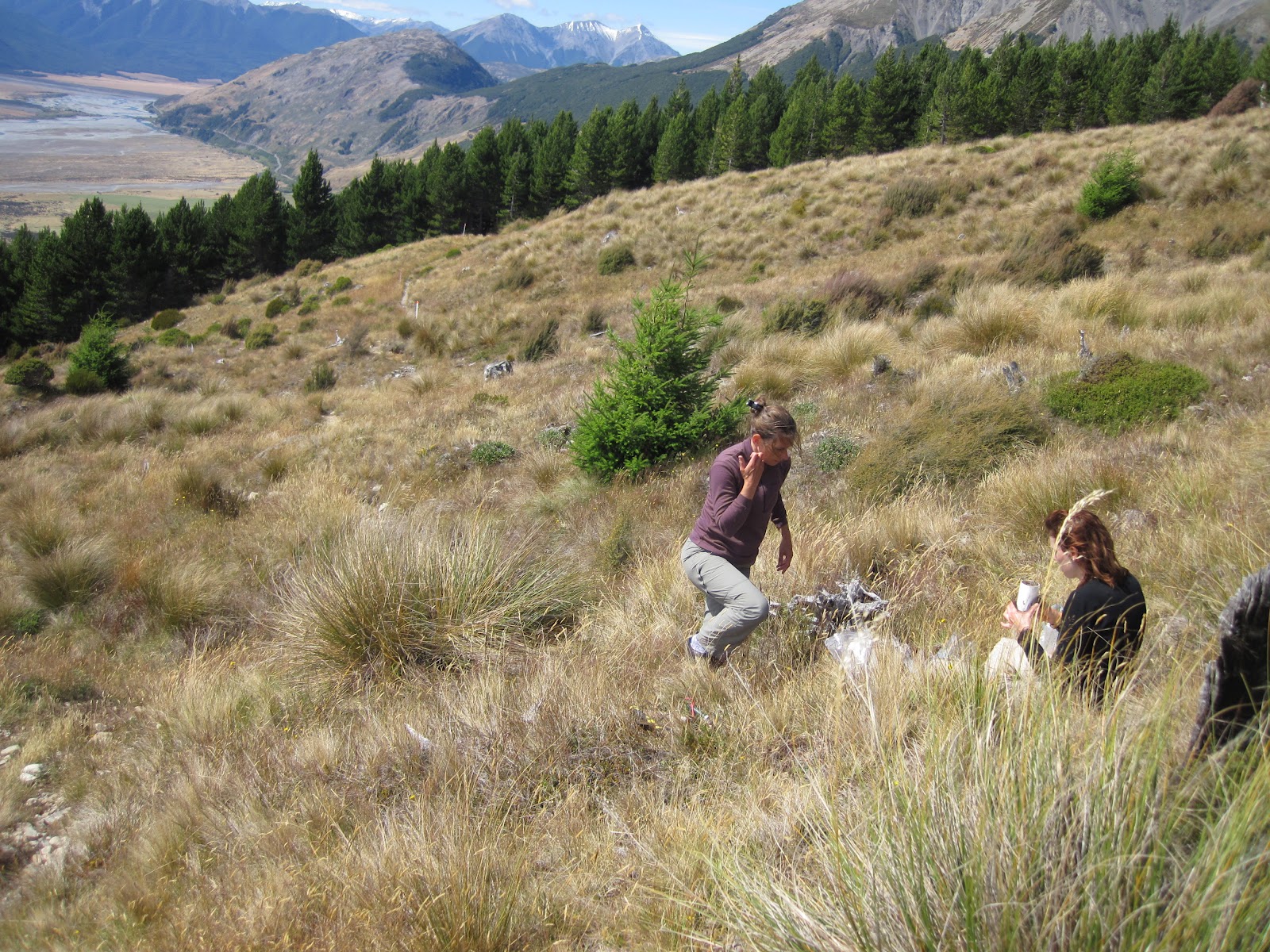
K. and J. extracting samples from a grassland. You can see a
pine plantation in the background, and a wilding Douglas-fir
just behind K. (in the purple shirt). The white tube in J.'s hands
is a newly-extracted soil core.
Together with the help of K. (who knows all the best ice cream spots on the South Island) and J. (who's generously loaning her strong arms and back in the name of seeing more of New Zealand), I'm collecting soil samples for a greenhouse bioassay (a glasshouse-based experiment using living organisms to test the properties of an environment).

This experiment is the natural complement to my survey of fungi infecting existing seedlings. In this case, I'm collecting soil from the same three canopy types (grassland, native beech forest, and Douglas-fir forest) at sites spread across the South Island of New Zealand (rather than the few local sites at which I collected my seedlings).  I'll plant Douglas-fir seeds in these soils, allow them to grow in the greenhouse for 6 to 9 months under the watchful eye of some helpful Landcare folks who will keep them happy and watered for me, and then harvest them to find out what fungi from the soils colonized the seedlings.